Chicken breast dries out quickly because it is lean, and package weight does not tell you how fast the center will heat. A wide, flat 8-ounce breast can finish before a compact 6-ounce breast that is much thicker. That is why a useful smoking plan starts with thickness, not ounces.
At 250°F, a boneless breast about 1 inch thick commonly takes 35 to 55 minutes; a thick 1 1/2-inch piece may need 55 to 80 minutes. Those are planning ranges. Every piece still needs to reach 165°F in its center.
Chicken Breast Smoking Time by Thickness
| Breast thickness | At 225°F | At 250°F | At 275°F |
|---|---|---|---|
| About 3/4 inch | 35 to 55 minutes | 25 to 45 minutes | 20 to 35 minutes |
| About 1 inch | 45 to 70 minutes | 35 to 55 minutes | 25 to 45 minutes |
| About 1 1/2 inches | 70 to 100 minutes | 55 to 80 minutes | 40 to 65 minutes |
Begin checking 10 to 15 minutes before the low end of the range. The table assumes fully thawed, boneless, skinless breasts placed in a preheated smoker with space between them. Bone-in pieces usually take longer, and a cold or windy cooker may recover slowly.
Clock time cannot prove safety. The USDA safe-temperature chart sets 165°F as the minimum for poultry breasts. Use that internal temperature as your finish line.
Which Smoker Temperature Should You Choose?
225°F: most smoke, narrowest margin
A 225°F chamber gives the meat more time around smoke, but it also extends the cook and makes a thin breast easier to oversmoke. This setting suits thick, evenly shaped pieces when you can monitor them closely.
250°F: the balanced starting point
For most boneless breasts, 250°F offers a practical balance of smoke exposure and cook time. It is the recommended starting point in this guide.
275°F: faster and lighter
At 275°F, the chicken finishes faster and usually takes on a lighter smoke profile. This setting is useful for thinner pieces or a weeknight schedule. Do not wait for the exterior to look dark; check the center early.
Ingredients and Equipment
Ingredients
- 4 boneless, skinless chicken breasts
- Kosher salt
- 1 tablespoon neutral oil
- 2 tablespoons salt-free poultry or barbecue seasoning
- Optional: 1 tablespoon melted unsalted butter for serving
Choose breasts that are close to the same thickness. If one end is extremely thick, place the breast between sheets of food-safe wrap and gently flatten the thick end just enough to make the shape more even. Do not pound it into a thin cutlet.
Equipment
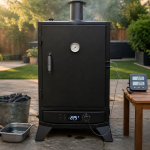
- Outdoor smoker stable at 250°F
- Leave-in probe for the thickest breast
- Fast instant-read thermometer for checking every piece
- Ruler or simple thickness gauge
- Clean tray and tongs for cooked chicken
- Apple, cherry, pecan, or a small amount of hickory wood
How to Smoke Chicken Breast
1. Measure the thickest point
Lay each breast flat and measure its tallest point. Group pieces into similar thickness bands. This 10-second step gives you a more useful starting time than reading the total package weight.
2. Dry-brine for better seasoning
Salt the chicken lightly and refrigerate it uncovered for 2 to 8 hours. A short dry brine seasons the interior and helps the surface dry. If your rub contains salt, reduce or skip the separate salt.
Do not leave raw chicken on the counter to “come to room temperature.” Keep it refrigerated until the smoker is ready.
3. Preheat the smoker to 250°F
Allow the smoker to stabilize, then add a small dose of mild wood. Chicken breast has little fat and a relatively small surface, so heavy smoke can turn bitter before the center finishes.
Apple and cherry are easy choices. Pecan adds a little more depth. If you use hickory, mix it with a milder wood or use less than you would for pork. Our wood-for-smoking guide has a broader pairing chart.
4. Season and place the probe from the side
Pat the chicken dry, coat it lightly with oil, and apply the seasoning. Insert a leave-in probe horizontally from the side of the thickest breast so its sensing tip lands in the center.
Side entry is especially important for thin food. USDA thermometer guidance says thin poultry should be checked from the side so the sensing area reaches the true center. A probe pushed down from the top may pass through the center and read the hotter grate-side layer.
5. Arrange with room for airflow
Place the breasts on the grate with space between them. Put thicker pieces toward the smoker’s slightly warmer zone and thinner pieces toward the cooler zone if you know the cooker’s pattern. Do not let raw pieces touch.
6. Start checking early
Use the table to choose the first check, then verify every breast separately. They will not all finish together. Move each finished piece to a clean tray only after its coldest center reaches 165°F.
A leave-in probe follows one piece; it does not certify the others. Spot-check from both sides if the breast has an irregular shape.
7. Rest briefly
Rest the chicken for 5 to 10 minutes before slicing. A long rest is unnecessary and can cool a small piece quickly. Slice across the visible muscle grain for a more tender bite.
Thickness Matters More Than Weight
Heat travels from the surface toward the center. Doubling the thickness creates a much longer path, while adding width mostly creates more portions. Two breasts can weigh the same and finish at different times because one is tall and compact and the other is broad and flat.
This is also why splitting an unusually thick breast horizontally can make meal timing easier. If you butterfly it, treat the resulting pieces as thinner cuts and use the early side of the table.
How to Keep Smoked Chicken Breast Moist
- Choose similar thicknesses. You can remove pieces separately, but a matched batch is easier to manage.
- Dry-brine instead of soaking by default. It adds seasoning without filling the surface with water.
- Use a moderate smoke dose. More time in heavy smoke does not make lean meat juicier.
- Probe the center correctly. A shallow reading can make you cook far past 165°F.
- Check each piece. The smallest breast may finish 20 minutes before the largest.
- Slice only what you will serve. Whole pieces hold moisture better than pre-sliced meat.
Dryness Troubleshooting
| Symptom | Likely cause | Next-cook fix |
|---|---|---|
| Dry throughout | Center cooked well beyond 165°F | Check earlier and verify probe placement from the side |
| Thin end dry, thick end good | Uneven shape | Gently even the thick end or tuck the thin tip underneath |
| Outside bitter | Heavy smoke or too much strong wood | Use clean, light smoke and a smaller wood dose |
| Outside pale and wet | Surface was wet or pieces were crowded | Pat dry, dry-brine uncovered, and leave airflow gaps |
| One breast unsafe while another is done | Different thicknesses | Cook in thickness groups and remove each piece separately |
Optional Flavor Variations
Herb and garlic
Use black pepper, garlic powder, thyme, and a small amount of rosemary. Pair with apple or pecan wood.
Sweet barbecue
Use a low-sugar rub during the smoke, then brush on a thin sauce layer during the final 5 to 10 minutes. Early sauce can scorch or become tacky before the center is safe.
Lemon pepper
Use lemon zest, cracked pepper, garlic powder, and salt. Avoid adding a large amount of acidic juice to the raw surface for a long hold; it can make the exterior texture pasty.
A current Traeger smoked chicken breast recipe uses 225°F, while its smoke-roasted chicken guidance uses a higher finishing stage. These are useful examples of the tradeoff: lower chamber heat extends smoke exposure; higher heat shortens the finish. The thickness table above lets you choose deliberately.
Frequently Asked Questions
How long does chicken breast take at 250°F?
Plan on about 35 to 55 minutes for a 1-inch breast and 55 to 80 minutes for a 1 1/2-inch breast. Start checking early and confirm 165°F in the center.
Do I need to flip chicken breast in a smoker?
Usually not in an indirect smoker with even airflow. Flip or rotate only if your cooker has a clear hot side or the underside is coloring much faster.
Can smoked chicken still look pink?
Yes. Smoke and natural pigments can leave safely cooked poultry pink. Internal temperature—not color—determines safety. Keep cooking if any cold spot is below 165°F.
Should I brine chicken breast before smoking?
You do not have to. A 2- to 8-hour dry brine is simple and keeps the surface dry. A wet brine can work, but it adds another variable and must stay refrigerated.
What if I am smoking bone-in chicken breast?
Bone-in breasts usually take longer. Insert the thermometer into the thickest meat without touching the bone, begin checking based on thickness, and expect the final time to extend beyond the boneless range.
The Bottom Line
How long you smoke chicken breast depends more on thickness than weight. Use 250°F as a balanced starting temperature, measure the thickest point, begin checking before the table’s low estimate, and verify every piece at 165°F.
If you are cooking an intact bird instead, use our separate whole smoked chicken guide; its breast-versus-thigh problem needs a different plan. For better readings on either cut, compare probe styles in our digital meat thermometer guide. Happy smoking!