The best smoked bologna recipe starts with a fully cooked chub, not raw sausage. Smoking reheats the ready-to-eat product, darkens a shallow scored surface, and sets a glaze. Diameter controls how long the center takes to warm more than total weight alone.
Quick answer: Verify “fully cooked” or “ready to eat” on the label, remove non-edible packaging, score the surface about ¼ inch deep in one-inch diamonds, and smoke at 225°F. Glaze during the final 30–45 minutes. For one simple endpoint that also serves at-risk diners, heat the cold center to 165°F.
Verify the Bologna Before Smoking
USDA describes bologna as a cooked sausage, but products and labels still vary. This method is only for a commercially prepared chub or log labeled fully cooked or ready to eat. A raw, partially cooked, shelf-stable dry sausage, or home-cured log requires different validated processing.
Read the complete label for casing instructions, allergens, storage, and reheating directions. Remove plastic wrap, clips, netting, and any casing specifically marked inedible. If the casing is edible and the label permits heating it, leaving it in place produces a different surface and can limit scoring.
| Label wording | Use this method? | Action |
|---|---|---|
| Fully cooked / ready to eat | Yes | Smoke and reheat |
| Cook before eating | No | Follow product-specific raw-sausage directions |
| Uncured but fully cooked | Yes, if label confirms | Refrigerate and follow package |
| Dry or shelf-stable sausage | Not this guide | Use a product-specific method |
| Label missing or unreadable | No | Do not guess |
Timing by Chub Diameter
| Chub diameter | Typical weight range | 225°F planning window to 165°F | Begin checking |
|---|---|---|---|
| 2–2½ inches | 1–2 pounds | 1½–2½ hours | At 1¼ hours |
| 2½–3½ inches | 2–4 pounds | 2½–3½ hours | At 2 hours |
| 3½–4½ inches | 4–6 pounds | 3–4½ hours | At 2½ hours |
| Over 4½ inches | Varies widely | 4 hours or more | Track with center probe |
These are planning ranges, not proof of temperature. Starting temperature, chub length, casing, smoker recovery, actual grate heat, and pan use affect the finish. A long narrow chub can warm sooner than a short thick one of the same weight.
Traeger’s current smoked bologna method uses a one-pound log at 225°F for 3–4 hours. That supports a low smoking setup but does not supply one endpoint for every label and diner. This guide checks the cold center and uses 165°F for a universal hot-service route.
Why 165°F Is the Clear Service Endpoint Here
Fully cooked bologna can be eaten according to its label without another safety cook. However, USDA advises people at higher risk of listeriosis—including pregnant people, older adults, and people with weakened immunity—to reheat bologna and other deli meats until steaming hot or 165°F.
Using 165°F for the whole batch creates one easy service rule. It also covers bologna being reheated as a leftover. Do not interpret it as permission to hold the chub in the smoker for hours after the center is hot; prolonged cooking can dry and split the surface.
Ingredients
- 1 fully cooked bologna chub, 1 to 6 pounds
- 2 tablespoons yellow or Dijon mustard
- 1 tablespoon barbecue rub with modest salt
- ½ cup barbecue sauce
- 1 tablespoon cider vinegar
- 1 teaspoon brown sugar or honey, optional
- 1 teaspoon hot sauce, optional
Bologna is already seasoned and usually high in sodium. Choose a low-salt rub and unsalted glaze components where possible. Taste a small cold slice before adding salt.
How to Score a Bologna Chub
1. Stabilize the log
Set the unwrapped chub on a dry cutting board. If it rolls, place clean towels beside it as stops. Never hold the log in your hand while making long scoring cuts.
2. Mark quarter-inch depth
Use a ruler to understand ¼ inch, or place a removable tape flag on the knife spine as a visual cue. Scoring is for surface expansion and glaze, not for cutting deep wedges.
3. Cut one-inch diagonals
Make parallel shallow cuts about one inch apart, then cross them at the opposite diagonal to create diamonds. Rotate the log carefully. Leave both ends intact if they help stabilize the chub.
4. Stop before the structure weakens
Deep scores can make slices split into chunks and expose too much surface to drying. Traeger’s official method also uses a ¼-inch score at one-inch intervals, a practical pattern for a one-pound log.
Smoker and Probe Setup
Preheat the smoker to 225°F with clean airflow. Hickory gives a stronger classic smoke; apple is milder and sweeter. Compare their behavior in our hickory smoking guide and apple wood guide.
Place the chub directly on clean grates for maximum surface exposure or on a wire rack over a pan for easier handling. A deep pan shields the lower surface and collects glaze, creating a softer bottom.
Insert a leave-in probe from one end along the centerline. The sensing area must reach the middle without exiting the side. For a short chub, enter from the side into the center. Our digital thermometer guide explains probe sensing zones.
Step-by-Step Smoked Bologna
1. Prepare the surface
Pat the chub dry after removing packaging. Apply a thin mustard binder, then a light coating of low-salt rub. Push a little seasoning into the scored grooves without packing them.
2. Smoke and let the diamonds open
Place the chub with space around it and close the lid. As the surface warms, the score pattern opens. Rotate once if the smoker has a documented hot side, but avoid frequent handling.
3. Check the cold center
Begin checks according to diameter. Use a clean instant-read probe from the opposite side to verify the leave-in reading. A probe touching the grate or sitting near the surface will read too high.
4. Glaze late
Mix barbecue sauce, vinegar, and optional sweetener or hot sauce. Brush a thin coat when the center reaches roughly 135–145°F. Apply a second light coat only after the first becomes tacky.
5. Finish at 165°F
Continue until the coldest center reaches 165°F and the glaze is set. Remove promptly to a clean board. If the glaze is dark before the center finishes, move the chub to a cooler zone and tent loosely with foil.
6. Rest and slice
Rest for 10 minutes. Slice into ¼-inch rounds for sandwiches or thicker wedges for appetizers. A very hot glazed surface can burn fingers, so use tongs or a fork only after moving the food to the serving board.
Glaze Timeline
| Stage | Center temperature | Surface action |
|---|---|---|
| Early smoke | Cold to about 120°F | No glaze; let smoke reach surface |
| Color building | About 120–140°F | Prepare glaze; inspect scores |
| First glaze | About 135–145°F | Brush a thin coat |
| Set and verify | 145–165°F | Optional second coat; monitor closely |
| Finish | 165°F cold center | Remove and rest |
The intermediate temperatures organize workflow; 165°F is the finish used here. Do not pull lower and assume carryover will satisfy high-risk reheating advice.
Whole Chub vs. Bologna Steaks
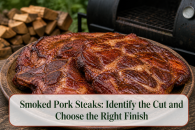
A whole chub warms slowly and gives the scored surface time to darken. Thick bologna steaks have far more cut surface and can be smoked or grilled quickly, but they need a separate thickness-based timetable.
For individual ground-meat patties, use the smoked burger guide. Bologna is already cooked sausage and should not be treated like raw ground beef, even when the serving shape looks similar.
Troubleshooting
The score pattern split too far
The cuts were deeper than ¼ inch or spaced too closely. Keep the next pattern shallow and wide. Slice across intact sections rather than lifting the hot chub by a scored edge.
The glaze burned
It went on too early, contained too much sugar, or sat over a hot spot. Apply it during the final 30–45 minutes in thin coats and rotate away from direct heat.
The center warms very slowly
The chub is thick, the probe may be misplaced, or the grate is cooler than the controller display. Verify actual chamber temperature and keep the cook continuous.
The surface is dry
Smoking continued too long after the center was hot, or the scores exposed too much area. Shorten the cook, reduce score depth, and rest only briefly.
The smoke is harsh
Bologna takes smoke at every scored edge. Use less wood and improve airflow. Old grease burning in the cooker can also create bitterness.
Food-Safety Boundaries
This recipe requires bologna labeled fully cooked or ready to eat. Do not apply it to raw or partially cooked sausage. Keep the chub refrigerated until the smoker is ready and follow any package-specific instructions.
USDA advises at-risk consumers to reheat bologna and other luncheon meats until steaming hot or 165°F. This guide uses 165°F as the batch endpoint. Keep raw-food tools away from the ready-to-eat chub and serving board.
Refrigerate leftovers in shallow covered containers within 2 hours, or within 1 hour above 90°F. Use opened ready-to-eat products within the package guidance; when reheating leftovers, return them to 165°F.
Sources
- USDA FSIS: Hot Dogs and Food Safety
- USDA FSIS: Preventing Listeriosis With Ready-to-Eat Products
- Traeger: Smoked Bologna
Verify the label, measure diameter, and keep the score shallow. A late glaze and a checked center give the chub smoke and color without turning a ready-to-eat product into an uncontrolled all-day cook.