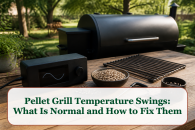
Best small smoker has a practical answer: A good small smoker has a genuinely small operating footprint, safe clearance, enough usable rack width for your usual food, and a fuel system you can store without occupying the whole patio. A useful shortlist begins with the food and space that must fit. Published area, rack count, and feature lists help narrow the field, but usable geometry, safe clearance, recovery, maintenance access, fuel, and current support determine whether a model belongs on it.
Best working rule: A good small smoker has a genuinely small operating footprint, safe clearance, enough usable rack width for your usual food, and a fuel system you can store without occupying the whole patio. The page’s practical tool is an operating-footprint versus food-fit worksheet.
This page owns limited-space home use; travel portability and cold-weather insulation have different owners. Published area and feature counts start the shortlist, but they do not prove food fit, access, recovery, safe clearance, or easy maintenance. Confirm the current model page and manual immediately before buying because prices and availability can change.
Start With the Exact Boundary
This page owns limited-space home use; travel portability and cold-weather insulation have different owners. Keeping that scope clear prevents a feature-rich model from being recommended before its food fit, operating space, fuel, and workload are verified.
Identify the appliance in full before applying a dimension, part, control sequence, or fault path. Photograph the model and serial plate, installed racks and attachments, fuel or power requirement, and cold operating footprint; a familiar family name is not a specification.
Evidence rule: current manufacturer pages control model fit, operating limits, and included features; government and recognized safety sources control food, fire, and fuel hazards. Prices and availability were checked on August 17, 2026, and can change. No first-hand product testing is claimed.
The Five Decisions at a Glance
| Decision | What applies here | Pass before continuing |
|---|---|---|
| Weber Smokey Mountain 14 | a compact charcoal smoker with two grates and a current $289 list price | Verify before moving to the next row |
| Traeger Ranger | 176 square inches and an 8-pound hopper in a 60-pound tabletop pellet unit | Verify before moving to the next row |
| Masterbuilt 30 electric | 710 square inches in a vertical cabinet but still requires outdoor clearance and power | Verify before moving to the next row |
| AKORN Jr | compact kamado efficiency with charcoal learning and a heavy heat-retaining body | Verify before moving to the next row |
| Storage | measure lid swing, chimney, handle, cord, grease bucket, and cover—not only the chassis | Verify before moving to the next row |
Treat every row as a gate, not a collection of bonus features. Published area matters only after usable food fit, safe operating clearance, fuel or power, maintenance access, and recovery are confirmed.
Use the Operating-footprint versus Food-fit Worksheet
Build a operating-footprint versus food-fit worksheet from the rows below. It keeps this page’s decisions, measurements, and stop points together so the result can be checked later instead of reconstructed from memory.
| Order | Decision | Action | Evidence to keep |
|---|---|---|---|
| 1 | Weber Smokey Mountain 14 | a compact charcoal smoker with two grates and a current $289 list price | Record the starting state and verified result |
| 2 | Traeger Ranger | 176 square inches and an 8-pound hopper in a 60-pound tabletop pellet unit | Record the starting state and verified result |
| 3 | Masterbuilt 30 electric | 710 square inches in a vertical cabinet but still requires outdoor clearance and power | Record the starting state and verified result |
| 4 | AKORN Jr | compact kamado efficiency with charcoal learning and a heavy heat-retaining body | Record the starting state and verified result |
| 5 | Storage | measure lid swing, chimney, handle, cord, grease bucket, and cover—not only the chassis | Record the starting state and verified result |
The completed record should identify Weber Smokey Mountain 14, Traeger Ranger, Masterbuilt 30 electric, AKORN Jr, Storage. Keep the evidence beside each row and mark any stop explicitly. The named products and methods are evaluated from cited current sources and transparent decision criteria; PickASmoker does not claim hands-on testing that did not occur.
1. Weber Smokey Mountain 14: Apply the Working Rule
Make one choice: a compact charcoal smoker with two grates and a current $289 list price. For this buyer path, the weber smokey mountain 14 row connects the real use to an observable fit evidence. Measure the actual food, door or lid path, operating footprint, and required clearance before comparing total square inches.
Result to look for: Put the food and operating-space measurements beside the current model dimensions before shortlisting it. Accept the row when the shortlist decision is stable enough to describe and repeat without guessing. A workaround ends the check if it defeats protection, conceals the coldest food spot, starves the fire, or strains the equipment.
- Capture: weber smokey mountain 14, the starting condition, the chosen setting, and the observation time.
- Check: the measured result against the operating-footprint versus food-fit worksheet and its applicable primary source.
- Adopt: the change only when safe operation is preserved and the result can be repeated.
2. Traeger Ranger: Apply the Working Rule
Action for this step: 176 square inches and an 8-pound hopper in a 60-pound tabletop pellet unit. For this buyer path, the traeger ranger row connects the real use to an observable fit evidence. Confirm usable rack width, vertical spacing, probe routing, grease access, and recovery with the exact current model—not a family name.
Proof of completion: Sketch door or lid movement, rack spacing, probe route, grease access, and required clearances. Accept the row when the shortlist decision is stable enough to describe and repeat without guessing. Stop if the result requires a defeated guard, an ignored food endpoint, a restricted vent, or a forced part.
- Log: traeger ranger, the starting condition, the chosen setting, and the observation time.
- Confirm: the measured result against the operating-footprint versus food-fit worksheet and its applicable primary source.
- Retain: the change only when safe operation is preserved and the result can be repeated.
3. Masterbuilt 30 electric: Apply the Working Rule
The decision: 710 square inches in a vertical cabinet but still requires outdoor clearance and power. For this buyer path, the masterbuilt 30 electric row connects the real use to an observable fit evidence. Match the fuel and power system to storage, weather, run time, attention level, and the local place where the cooker will be used.
Field verification: Confirm the fuel or power routine for a normal long cook, including weather protection and storage. Accept the row when the shortlist decision is stable enough to describe and repeat without guessing. The row fails when it can be completed only by overriding a manual limit, safety device, verified endpoint, or physical fit.
- Log: masterbuilt 30 electric, the starting condition, the chosen setting, and the observation time.
- Cross-check: the measured result against the operating-footprint versus food-fit worksheet and its applicable primary source.
- Retain: the change only when safe operation is preserved and the result can be repeated.
4. AKORN Jr: Apply the Working Rule
Working rule: compact kamado efficiency with charcoal learning and a heavy heat-retaining body. For this buyer path, the akorn jr row connects the real use to an observable fit evidence. Check the current manufacturer page and manual for included parts, temperature range, weight, warranty, and support before relying on a retailer listing.
Observable pass: Save the dated manufacturer specification or manual page that supports every shortlisted claim. Accept the row when the shortlist decision is stable enough to describe and repeat without guessing. Only a result achieved with intact safeguards, verified food safety, open airflow, and normal component fit can pass.
- Capture: akorn jr, the starting condition, the chosen setting, and the observation time.
- Confirm: the measured result against the operating-footprint versus food-fit worksheet and its applicable primary source.
- Keep: the change only when safe operation is preserved and the result can be repeated.
5. Storage: Apply the Working Rule
What to do: measure lid swing, chimney, handle, cord, grease bucket, and cover—not only the chassis. For this buyer path, the storage row connects the real use to an observable fit evidence. Shortlist only models that pass food fit, safe operation, routine maintenance, and ownership workload; price breaks a tie after those gates.
How to prove it: Reject any model that fails a gate, then compare price and convenience among the models that remain. Accept the row when the shortlist decision is stable enough to describe and repeat without guessing. A pass cannot depend on bypassing a safety control, guessing at doneness, choking exhaust, or making hardware fit by force.
- Record: storage, the starting condition, the chosen setting, and the observation time.
- Validate: the measured result against the operating-footprint versus food-fit worksheet and its applicable primary source.
- Repeat: the change only when safe operation is preserved and the result can be repeated.
Connect This Decision to the Rest of the Site
For the closest supporting decision, use practical smoker sizing guide. Continue to portable smoker guide only for the neighboring job named in that link, and use beginner smoker buyer guide when the food, cooker, fuel, or fit moves beyond this page’s stated scope.
Bring the result back to the operating-footprint versus food-fit worksheet and record which linked assumption changed. This preserves the intent of each page instead of blending unrelated temperature, equipment, fuel, or safety rules.
What Went Wrong? Use the Symptom Table
| Symptom | Likely cause | Next controlled move |
|---|---|---|
| Fits storage but not operation | clearance and lid swing were omitted | draw both stored and hot operating rectangles |
| Rack is too narrow | total area hid unusable geometry | trace the normal food on cardboard |
| Neighbor smoke conflict | exhaust direction and local rules were ignored | check rules and orient only within safe placement limits |
Use this symptom table only inside the boundary defined for Best Small Smokers for Patios and Limited Outdoor Space. Match the symptom exactly, preserve the other conditions, and make the stated low-risk correction; uncertain food endpoints, live fuel or electrical systems, damaged safety parts, and structural faults require the authoritative route named in this guide.
1. Fits storage but not operation
The likely explanation is clearance and lid swing were omitted. The next controlled move is to draw both stored and hot operating rectangles. Resolve this issue with measurements or the current manual before keeping the model on the list.
2. Rack is too narrow
The likely explanation is total area hid unusable geometry. The next controlled move is to trace the normal food on cardboard. Treat the failed fit or ownership check as a gate, not a feature to explain away.
3. Neighbor smoke conflict
The likely explanation is exhaust direction and local rules were ignored. The next controlled move is to check rules and orient only within safe placement limits. If the current source cannot verify the correction, remove the model until it can be confirmed.
Final Pre-Cook or Pre-Purchase Checklist
- Weber Smokey Mountain 14: a compact charcoal smoker with two grates and a current $289 list price; the pass condition is recorded.
- Traeger Ranger: 176 square inches and an 8-pound hopper in a 60-pound tabletop pellet unit; the pass condition is recorded.
- Masterbuilt 30 electric: 710 square inches in a vertical cabinet but still requires outdoor clearance and power; the pass condition is recorded.
- AKORN Jr: compact kamado efficiency with charcoal learning and a heavy heat-retaining body; the pass condition is recorded.
- Storage: measure lid swing, chimney, handle, cord, grease bucket, and cover—not only the chassis; the pass condition is recorded.
- Usable food fit and operating clearance are measured, not inferred from total area.
- Fuel, power, maintenance, recovery, storage, and support fit the normal routine.
- Every shortlist claim is saved from the exact current manufacturer source.
Frequently Asked Questions
What is the short answer for best small smoker?
A good small smoker has a genuinely small operating footprint, safe clearance, enough usable rack width for your usual food, and a fuel system you can store without occupying the whole patio. The answer stays deliberately narrow because this page owns limited-space home use; travel portability and cold-weather insulation have different owners.
Which claim matters most for best small smoker?
Recheck the official product page and manual on the day of purchase. Price, stock, model generation, included accessories, and warranty can change. For this topic, record weber smokey mountain 14, masterbuilt 30 electric, and storage beside the number or claim. Without those conditions, it should not be treated as universal.
What belongs in the operating-footprint versus food-fit worksheet?
Use the operating-footprint versus food-fit worksheet and label its five rows: Weber Smokey Mountain 14, Traeger Ranger, Masterbuilt 30 electric, AKORN Jr, Storage. Add the observation time and verified outcome to each completed row, including any condition that forced a stop.
Stop when neighbor smoke conflict cannot be resolved with the stated low-risk move: check rules and orient only within safe placement limits. Any gas odor, repeated trip, damaged wiring, structural failure, blocked combustion path, defeated guard, or unverifiable food endpoint also closes the low-risk route.
Does this guidance apply beyond best small smoker?
Only after confirming the boundary. This page owns limited-space home use; travel portability and cold-weather insulation have different owners. Similar size, color, brand, or cooking area does not prove identical geometry, hardware, label state, or food-safety needs. Use the exact model plate, package wording, and current primary source.
Sources and Verification Notes
These primary sources were checked on August 17, 2026 for the claims used in the operating-footprint versus food-fit worksheet. Recheck the exact model page and manual for dated specifications; current government food and fire guidance controls over an old recipe, retailer summary, or forum shortcut.
- Weber: Smokey Mountain Cooker Smoker 14 — Current U.S. price and 14-inch model availability.
- Traeger: Ranger Portable Pellet Grill — Current price, 176-square-inch area, 60-pound weight, 8-pound hopper, power, and range.
- Masterbuilt: 30-Inch Digital Electric Smoker — Current price, model, area, racks, maximum temperature, and outdoor limits.
- Char-Griller: AKORN Kamado Grills — Current AKORN and AKORN Jr. prices, insulated steel design, and product family.
Return to the working answer: A good small smoker has a genuinely small operating footprint, safe clearance, enough usable rack width for your usual food, and a fuel system you can store without occupying the whole patio. Complete the operating-footprint versus food-fit worksheet, keep its evidence, and refine only the row the result supports. That produces a more useful next cook, diagnosis, comparison, or purchase than changing several inputs at once.