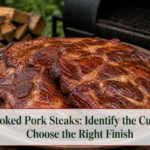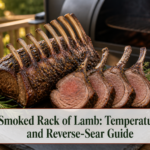
Why is my smoked meat dry has a practical answer: Dry smoked meat usually comes from the wrong cut endpoint, a misplaced probe, excess direct heat, late checking, or premature slicing—not simply from skipping a water pan. Diagnosis starts with a cold baseline and a repeatable symptom. Confirm fuel, power, placement, probe location, and operating state before changing one low-risk variable; a symptom by itself does not prove a failed part.
Best working rule: Dry smoked meat usually comes from the wrong cut endpoint, a misplaced probe, excess direct heat, late checking, or premature slicing—not simply from skipping a water pan. The page’s practical tool is a dryness symptom-to-cause diagnostic tree.
This is a cross-cut diagnostic; each meat-specific recipe still owns its safe endpoint and detailed cook plan. Do not replace parts from a symptom alone. Photograph the cold baseline, verify power or fuel is off before inspection, change one low-risk variable, and stop at wiring, gas-valve, structural, or combustion-control work that belongs to qualified support.
Start With the Exact Boundary
This is a cross-cut diagnostic; each meat-specific recipe still owns its safe endpoint and detailed cook plan. Keeping that scope clear prevents a similar-looking symptom from being treated as proof of the same cause or failed component.
Identify the appliance in full before applying a dimension, part, control sequence, or fault path. Photograph the model and serial plate, installed racks and attachments, fuel or power requirement, and cold operating footprint; a familiar family name is not a specification.
Evidence rule: current manufacturer pages control model fit, operating limits, and included features; government and recognized safety sources control food, fire, and fuel hazards. Dated model specifications and instructions can change, so recheck the exact current manual. No first-hand product testing is claimed.
The Five Decisions at a Glance
| Decision | What applies here | Pass before continuing |
|---|---|---|
| Lean and fatty cuts | tenderloin dries from overcooking while brisket can feel dry when under-rendered | Verify before moving to the next row |
| Probe error | a tip near bone, fat, or the surface can report a false finish | Verify before moving to the next row |
| Heat map | radiant exposure can dry one face even when average pit temperature looks correct | Verify before moving to the next row |
| Check window | time predicts when to inspect but cannot decide doneness | Verify before moving to the next row |
| Rest and slicing | rest appropriately and cut across the grain only when service is ready | Verify before moving to the next row |
Complete the rows in order because a later diagnosis assumes the cold baseline and earlier checks are known. Do not replace a part or open a live fuel or electrical system from a display reading alone.
Use the Dryness Symptom-to-cause Diagnostic Tree
Build a dryness symptom-to-cause diagnostic tree from the rows below. It keeps this page’s decisions, measurements, and stop points together so the result can be checked later instead of reconstructed from memory.
| Order | Decision | Action | Evidence to keep |
|---|---|---|---|
| 1 | Lean and fatty cuts | tenderloin dries from overcooking while brisket can feel dry when under-rendered | Record the starting state and verified result |
| 2 | Probe error | a tip near bone, fat, or the surface can report a false finish | Record the starting state and verified result |
| 3 | Heat map | radiant exposure can dry one face even when average pit temperature looks correct | Record the starting state and verified result |
| 4 | Check window | time predicts when to inspect but cannot decide doneness | Record the starting state and verified result |
| 5 | Rest and slicing | rest appropriately and cut across the grain only when service is ready | Record the starting state and verified result |
The completed record should identify Lean and fatty cuts, Probe error, Heat map, Check window, Rest and slicing. Keep the evidence beside each row and mark any stop explicitly. The named products and methods are evaluated from cited current sources and transparent decision criteria; PickASmoker does not claim hands-on testing that did not occur.
1. Lean and fatty cuts: Apply the Working Rule
Working rule: tenderloin dries from overcooking while brisket can feel dry when under-rendered. For this diagnostic path, the lean and fatty cuts row connects the symptom to an observable single-variable test. Capture the exact symptom, when it appears, and the cold starting state before cleaning, moving, resetting, or replacing anything.
Observable pass: Photograph the symptom and cold component arrangement before cleaning residue or moving a control. Accept the row when the confirmed cause is stable enough to describe and repeat without guessing. The row fails when it can be completed only by overriding a manual limit, safety device, verified endpoint, or physical fit.
- Capture: lean and fatty cuts, the starting condition, the chosen setting, and the observation time.
- Confirm: the measured result against the dryness symptom-to-cause diagnostic tree and its applicable primary source.
- Keep: the change only when safe operation is preserved and the result can be repeated.
2. Probe error: Apply the Working Rule
What to do: a tip near bone, fat, or the surface can report a false finish. For this diagnostic path, the probe error row connects the symptom to an observable single-variable test. Separate a normal operating cycle from a fault by observing a complete preheat or response window under the same conditions.
How to prove it: Log a full preheat and trend under the same load so a normal cycle is not mistaken for a failure. Accept the row when the confirmed cause is stable enough to describe and repeat without guessing. Only a result achieved with intact safeguards, verified food safety, open airflow, and normal component fit can pass.
- Record: probe error, the starting condition, the chosen setting, and the observation time.
- Validate: the measured result against the dryness symptom-to-cause diagnostic tree and its applicable primary source.
- Repeat: the change only when safe operation is preserved and the result can be repeated.
3. Heat map: Apply the Working Rule
Controlled move: radiant exposure can dry one face even when average pit temperature looks correct. For this diagnostic path, the heat map row connects the symptom to an observable single-variable test. Check the simplest external cause first—fuel condition, placement, airflow, residue, probe position, power, or weather—without opening a live system.
Check before continuing: Compare the named external check with the baseline without opening a powered, pressurized, or fueled system. Accept the row when the confirmed cause is stable enough to describe and repeat without guessing. A pass cannot depend on bypassing a safety control, guessing at doneness, choking exhaust, or making hardware fit by force.
- Note: heat map, the starting condition, the chosen setting, and the observation time.
- Compare: the measured result against the dryness symptom-to-cause diagnostic tree and its applicable primary source.
- Preserve: the change only when safe operation is preserved and the result can be repeated.
4. Check window: Apply the Working Rule
Apply this row: time predicts when to inspect but cannot decide doneness. For this diagnostic path, the check window row connects the symptom to an observable single-variable test. Make one reversible correction and repeat the same measurement; multiple simultaneous fixes destroy the evidence needed to identify the cause.
Evidence at the cooker: Make the reversible correction, wait the same interval, and record whether the symptom actually changed. Accept the row when the confirmed cause is stable enough to describe and repeat without guessing. Do not accept a convenient result produced by an unsafe temperature, blocked airflow, improvised connection, or damaged part.
- Document: check window, the starting condition, the chosen setting, and the observation time.
- Verify: the measured result against the dryness symptom-to-cause diagnostic tree and its applicable primary source.
- Use again: the change only when safe operation is preserved and the result can be repeated.
5. Rest and slicing: Apply the Working Rule
Set the condition: rest appropriately and cut across the grain only when service is ready. For this diagnostic path, the rest and slicing row connects the symptom to an observable single-variable test. Escalate unresolved gas, wiring, structural, controller, or combustion faults instead of converting a diagnostic article into a repair authorization.
Acceptance check: If the symptom survives the safe checks, preserve the evidence and contact the manufacturer or qualified service. Accept the row when the confirmed cause is stable enough to describe and repeat without guessing. If the named check cannot pass under normal safe operation, stop and use the authoritative route instead of improvising.
- Write down: rest and slicing, the starting condition, the chosen setting, and the observation time.
- Corroborate: the measured result against the dryness symptom-to-cause diagnostic tree and its applicable primary source.
- Carry forward: the change only when safe operation is preserved and the result can be repeated.
Connect This Decision to the Rest of the Site
For the closest supporting decision, use smoking times and safe-temperature chart. Continue to meat-probe placement guide only for the neighboring job named in that link, and use tough brisket rescue guide when the food, cooker, fuel, or fit moves beyond this page’s stated scope.
Bring the result back to the dryness symptom-to-cause diagnostic tree and record which linked assumption changed. This preserves the intent of each page instead of blending unrelated temperature, equipment, fuel, or safety rules.
What Went Wrong? Use the Symptom Table
| Symptom | Likely cause | Next controlled move |
|---|---|---|
| Dry but tough brisket | collagen has not softened despite moisture loss | continue a protected cook until several areas probe tender |
| Dry poultry breast | the center exceeded the safe endpoint | place the probe deeper and begin checking sooner |
| Dry edges only | radiant heat or thin geometry finished first | shield or reposition the vulnerable side |
Use this symptom table only inside the boundary defined for Why Is My Smoked Meat Dry? Causes and Practical Fixes. Match the symptom exactly, preserve the other conditions, and make the stated low-risk correction; uncertain food endpoints, live fuel or electrical systems, damaged safety parts, and structural faults require the authoritative route named in this guide.
1. Dry but tough brisket
The likely explanation is collagen has not softened despite moisture loss. The next controlled move is to continue a protected cook until several areas probe tender. Check this external cause before opening or replacing a component.
2. Dry poultry breast
The likely explanation is the center exceeded the safe endpoint. The next controlled move is to place the probe deeper and begin checking sooner. Repeat the same measurement after one reversible correction.
3. Dry edges only
The likely explanation is radiant heat or thin geometry finished first. The next controlled move is to shield or reposition the vulnerable side. If the symptom remains, preserve the log and escalate beyond the low-risk diagnostic boundary.
Final Pre-Cook or Pre-Purchase Checklist
- Lean and fatty cuts: tenderloin dries from overcooking while brisket can feel dry when under-rendered; the pass condition is recorded.
- Probe error: a tip near bone, fat, or the surface can report a false finish; the pass condition is recorded.
- Heat map: radiant exposure can dry one face even when average pit temperature looks correct; the pass condition is recorded.
- Check window: time predicts when to inspect but cannot decide doneness; the pass condition is recorded.
- Rest and slicing: rest appropriately and cut across the grain only when service is ready; the pass condition is recorded.
- The cold baseline and exact symptom are recorded before cleaning or resetting.
- The first correction is external, reversible, and tested under the same conditions.
- Gas, wiring, structural, controller, and combustion repairs remain with qualified support.
Frequently Asked Questions
What is the short answer for why is my smoked meat dry?
Dry smoked meat usually comes from the wrong cut endpoint, a misplaced probe, excess direct heat, late checking, or premature slicing—not simply from skipping a water pan. The answer stays deliberately narrow because this is a cross-cut diagnostic; each meat-specific recipe still owns its safe endpoint and detailed cook plan.
Which claim matters most for why is my smoked meat dry?
No. A symptom narrows the next check; it does not prove a failed part. Confirm the baseline and change one low-risk variable. For this topic, record lean and fatty cuts, heat map, and rest and slicing beside the number or claim. Without those conditions, it should not be treated as universal.
What belongs in the dryness symptom-to-cause diagnostic tree?
Use the dryness symptom-to-cause diagnostic tree and label its five rows: Lean and fatty cuts, Probe error, Heat map, Check window, Rest and slicing. Add the observation time and verified outcome to each completed row, including any condition that forced a stop.
Stop when dry edges only cannot be resolved with the stated low-risk move: shield or reposition the vulnerable side. Any gas odor, repeated trip, damaged wiring, structural failure, blocked combustion path, defeated guard, or unverifiable food endpoint also closes the low-risk route.
Does this guidance apply beyond why is my smoked meat dry?
Only after confirming the boundary. This is a cross-cut diagnostic; each meat-specific recipe still owns its safe endpoint and detailed cook plan. Similar size, color, brand, or cooking area does not prove identical geometry, hardware, label state, or food-safety needs. Use the exact model plate, package wording, and current primary source.
Sources and Verification Notes
These primary sources were checked on August 17, 2026 for the claims used in the dryness symptom-to-cause diagnostic tree. Recheck the exact model page and manual for dated specifications; current government food and fire guidance controls over an old recipe, retailer summary, or forum shortcut.
- USDA FSIS: Smoking Meat and Poultry — Outdoor smoking range, thawing, thermometer use, and safe minimums.
- USDA FSIS: Food Thermometers — Food-thermometer placement, sensing, and calibration context.
- USDA FSIS: Leftovers and Food Safety — Two-hour limit, shallow containers, cold storage, and reheating.
Return to the working answer: Dry smoked meat usually comes from the wrong cut endpoint, a misplaced probe, excess direct heat, late checking, or premature slicing—not simply from skipping a water pan. Complete the dryness symptom-to-cause diagnostic tree, keep its evidence, and refine only the row the result supports. That produces a more useful next cook, diagnosis, comparison, or purchase than changing several inputs at once.